AI has become the defining theme across the tech sector, accounting for much of the industry’s focus while helping drive strong earnings growth over the past few years. At the same time, it is also transforming the software industry, where the rise of AI agents has raised concerns that some traditional software-as-a-service (SaaS) products could become less valuable or even unnecessary as AI takes over tasks that once required dedicated applications. Those concerns have given rise to what analysts have dubbed the “SaaSpocalypse.”
However, Goldman Sachs’ Gabriela Borges sees a potential path toward a software recovery, arguing that some companies stand to benefit as AI reshapes the industry and creates new product opportunities. In particular, the analyst believes the customer experience software market offers attractive near- to mid-term opportunities.
“The customer experience market is in an AI-driven evolution, with significant disruption to incumbents in part of the market (Customer Service) causing investors to question the durability of the entire category. Based on our industry conversations and fundamental analysis, we arrive at the following key conclusions: 1) the tailwind for companies that are able to benefit from the disruption in customer service will likely last multiple years vs. just a near term driver of upside and 2) marketing is relatively resilient as a category given these companies generally have a differentiated infrastructure layer, something that we think is misunderstood in the market today,” Borges stated.
Based on that view, Borges has singled out two software stocks she believes are positioned to capitalize on the transformation. The analyst sees each climbing by at least 60% over the next 12 months. We turned to the TipRanks database to examine her picks and the rationale behind them.
The first of Goldman’s picks that we’re looking at here is Klaviyo, a leader in business-to-customer CRM, or customer relationship management. Klaviyo’s subscription-based Data Platform makes use of AI to analyze customer data and interactions, allowing business customers to better understand customer behavior.
As with all CRM, the key effect here, for Klaviyo’s customers, is the ability to put together direct marketing efforts that are better branded, better targeted, and more effective. Klaviyo’s agentic AI tech is a vital part of this picture, making available automated agents that see the whole customer picture, including purchase histories and real-time data. In short, Klaviyo gives its customers chatbots that are smart and capable, able to recommend products, assist in user purchases, and move the conversation along around the clock – far more than just answering questions.
Klaviyo has even developed an AI helpdesk. Business customers reap the benefits of AI agents that read the full customer database, including the full history of each customer’s interactions with the business, marketing engagements, and loyalty status. The company’s AI agents are even able to hand off customer contacts to human agents, giving contact history and context for a seamless, efficient switch.
Ultimately, Klaviyo has been able to leverage these capabilities to become a popular B2C CRM choice for direct marketers and e-commerce vendors. As of March 31 this year, the company could boast more than 196,000 customers and some $358 million in quarterly revenue – and 28% year-over-year revenue growth. The company realized a bottom line in 1Q26 of 22 cents per share in non-GAAP earnings, beating the forecast by 2 cents per share.
Despite those solid results, the company’s stock fell sharply after the earnings release following the announcement that CFO Amanda Whalen will step down in August. Whalen guided Klaviyo through its transition to the public markets, and her departure created uncertainty as the company begins the search for a new CFO. In addition, there are worries about future revenue growth. Guidance for the rest of the year points to 23% year-over-year revenue growth, a sharp slowdown from the 28% posted in Q1.
But Goldman Sachs’ Borges has laid out a case for a turnaround, arguing that the recent selloff has created an opportunity rather than signaling a deterioration in the business.
“Klaviyo’s exposure to a wide variety of growth vectors gives us confidence in the health of the underlying business, particularly with revenue growth still in the high 20s. We believe in Klaviyo’s ability to 1) continue expanding with its existing customer base and within the Shopify ecosystem, 2) expand into new markets (up-market, international, and outside of eCommerce), and 3) benefit from multiple new product cycles (Service & AI). In our view, this gives Klaviyo multiple ways to outperform over the medium term,” the analyst opined.
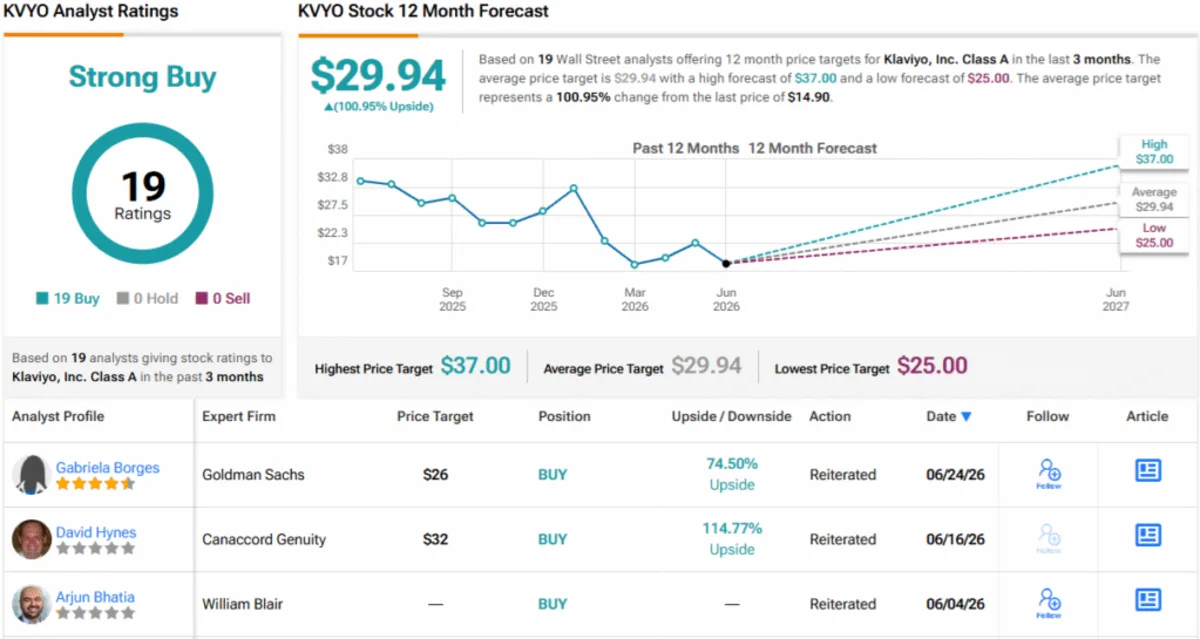
Based on this stance, Borges puts a Buy rating on Klaviyo, along with a price target of $26, suggesting a 74.5% upside over the next year. (To watch Borges’ track record, click here)
So, that’s the Goldman view. But what does the rest of the Street think? If anything, it’s even more bullish. All 19 analysts covering KVYO rate it a Buy, giving the shares a unanimous Strong Buy consensus rating. With the stock trading at $14.90, the average price target of $29.94 implies one-year upside potential of ~101%. (See KVYO stock forecast)
The next stock on our list of Goldman picks is Braze, a software company that focuses on improving and enabling customer engagement for an enterprise client base. Braze gives its own customers access to a platform that builds on multi-channel and cloud-based marketing and, importantly, allows users to drive sales by building solid relationships with their own target audiences. Braze has built its platform to prioritize moving end customers from information, or ‘finding out,’ to buying – and to do so at whatever pace is suitable.
It’s a data-driven approach, designed to build platform functionality by drawing data from a wide range of sources. That broad data foundation allows Braze’s clients to engage customers throughout the marketing funnel. The platform uses AI to deliver personalized messaging and real-time data analysis, making Braze a leader in AI-powered customer engagement.
BrazeAI, the company’s dedicated AI platform, helps businesses keep their marketing efforts effective as technology and customer expectations continue to evolve. It uses AI to generate personalized messages, content, and product recommendations while analyzing customer data in real time to improve engagement. BrazeAI also automates key marketing workflows, helping move customers through the sales funnel more efficiently. That streamlined process enables faster responses to customer needs and ultimately contributes to stronger sales and marketing execution.
However, Braze’s latest quarterly results gave investors some mixed signals. Alongside its fiscal 1Q27 report, the company raised its full-year revenue guidance to between $895 million and $899 million, up from its previous outlook of $884 million to $889 million. However, it left its full-year non-GAAP EPS guidance unchanged at $0.61 to $0.65. That disappointed investors, as the higher revenue outlook suggested stronger growth, but not stronger profitability.
What we saw for fiscal 1Q27 at the top and bottom lines bore that out. Revenue, at $211 million, was up 30% year-over-year and beat the forecast by $5.8 million – but the non-GAAP quarterly EPS of 10 cents, while up 3 cents year-over-year, did not exceed expectations, coming in line with the forecast.
Nevertheless, Borges, in her coverage of the stock, charts a positive course: “We see Braze as well positioned to continue taking share from legacy marketing tools as AI increases the strain of legacy tech debt within organizations. Braze’s ability to give marketers the power to orchestrate sophisticated campaigns is becoming more important as customer expectations rise. We believe that Braze is seeing the benefit from business model improvements that can drive healthier unit economics going forward, which gives us confidence that Braze can deliver 20% operating margins by 2029.”
The Goldman analyst sets a Buy rating here and backs that with a price target of $34, pointing toward a one-year upside of ~62%.
Overall, Braze stock also gets a unanimous Strong Buy consensus rating, based on 17 recent analyst reviews. The shares are trading for $21.02, and their average target price of $35.07 indicates potential for a ~67% gain on the one-year horizon. (See BRZE stock forecast)
Disclaimer: The opinions expressed in this article are solely those of the featured analyst. The content is intended to be used for informational purposes only. It is very important to do your own analysis before making any investment.